
 +1
(905) 282-0881
+1
(905) 282-0881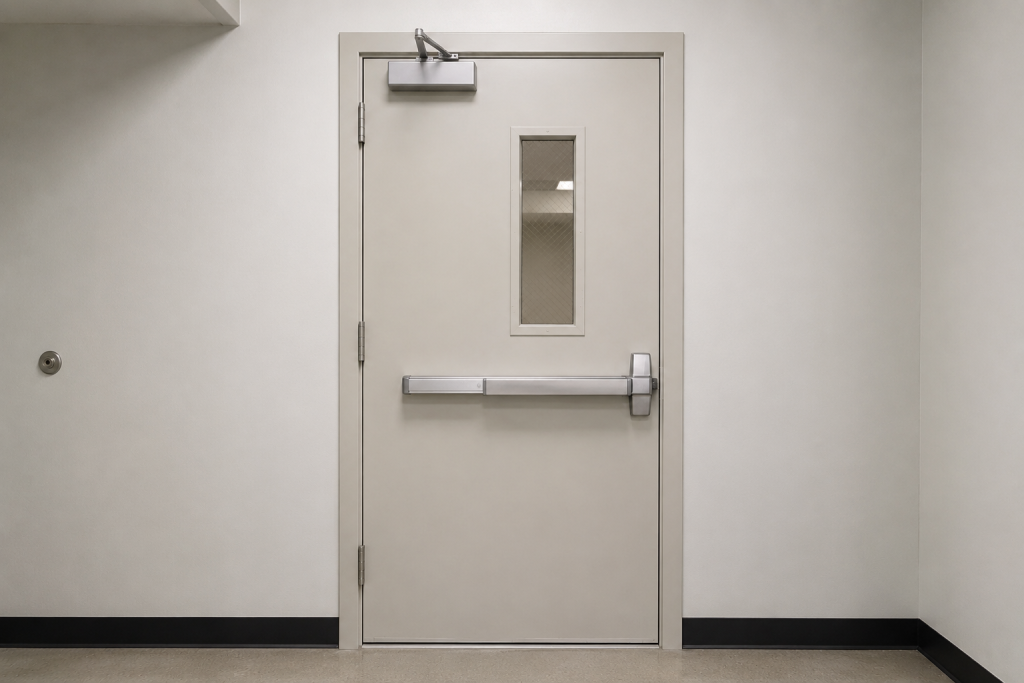
Fire can spread faster than most people expect — and in a garage, where fuel, oil, and other flammable materials are often stored, the risk is especially high. In Canada, whether you need fire-rated doors in a garage depends on several layers of regulation, including the National Building Code of Canada (NBC), the National Fire Code of Canada (NFCC), and provincial building codes that may impose additional requirements.
The NBC sets the minimum standards for building construction and safety across the country, applying to most commercial, industrial, and residential properties. The NFCC addresses fire safety practices in greater detail, including how fire doors must perform during a fire event. Fire-rated doors must also meet standards such as CAN/ULC-S104, which governs fire tests for door assemblies, and the NBC references NFPA 80-2007, the Standard for Fire Doors and Other Opening Protectives.
That is a lot of overlapping codes to keep track of — and the consequences of getting it wrong can be serious. Non-compliance may lead to failed inspections, fines, increased liability, and significant insurance complications.
Province-Specific Requirements for Garage Fire-Rated Doors
The specific requirements for fire-rated doors in garages depend on the building type, its use, and the province. The fundamental principle is straightforward: if a wall is fire-rated, the door within it must be too. Fire-rated doors are required wherever a fire separation exists, and this applies to commercial, industrial, and residential buildings alike.
In Ontario, fire-rated doors are typically required between an attached garage and the living space, as well as in utility rooms, basements, and multi-unit residential buildings. For most single-family homes, a 20-minute fire-rated door is the standard. There is, however, a notable exemption: a fire separation between the garage and home is not required for single-family dwellings, provided the separation is fumeproof.
Alberta takes a more classification-based approach. Storage garages must be separated from other occupancies by a fire separation with at least a 1.5-hour fire-resistance rating. Garages holding five or fewer vehicles require a minimum 1-hour separation. Where a storage garage serves only its attached dwelling unit, it may be considered part of that unit — and the fire separation requirement may not apply.
Requirements for Commercial and Multi-Family Garages
For business owners operating commercial, multi-family, or mixed-use buildings, requirements become more stringent. In British Columbia, garages that are part of these building types fall under higher ratings and additional requirements set out in BCBC Sections 3.2 and 3.3. Quebec operates under its own Safety Code, Chapter VIII, which includes province-specific provisions addressing fire safety, building façade inspections, and multi-storey garage maintenance.
The stakes behind these regulations are real. Ontario, Quebec, Alberta, British Columbia, Manitoba, and Saskatchewan account for 90 per cent of fires in Canada, and roughly 80 per cent of fire deaths happen in residential properties. According to Statistics Canada, in 2021 there were 202 fire-related deaths in Canada, with three out of four occurring in residences.
Garages are especially hazardous: vehicles, fuel, paints, and tools are all potential ignition sources sitting just metres from living or working spaces. Fire-rated doors are part of a compartmentalization strategy — dividing a building into smaller fire-resistant sections to slow the spread of flames and smoke. That extra time can mean the difference between a controlled evacuation and a catastrophe.
Inspection and Maintenance Obligations
Annual inspections for fire-rated doors have been mandatory under NFPA 80 since 2007. All fire-rated commercial doors must be tested at least once per year, with signed written records kept on file for review by the Authority Having Jurisdiction. Alberta goes further — fire doors there should be tested monthly and visually inspected every 24 hours. Ontario's Fire Code (O. Reg. 213/07) similarly requires building owners to keep fire doors in proper working order at all times.
What do these inspections actually involve? Technicians perform drop tests to confirm doors close fully during an emergency and smoke tests to verify they prevent smoke passage between compartments. These two functions are only useful if the door actually works when it matters.
The consequences of skipping these obligations are significant. Failed inspections can trigger building code violations and fines. If a neglected fire door contributed to damage or injury during a fire, the building owner may be held legally liable. Insurers can deny claims when non-compliant doors are found to have worsened losses, and fire marshals have the authority to order a facility closed until all life-safety violations are corrected.
Navigating Fire-Rated Door Requirements in Canada
When navigating fire-rated door requirements in Canada, having the right supplier makes all the difference. ADH Ecogen, a Canadian-owned B2B manufacturer based in Mississauga, Ontario, specializes in certified fire door solutions built to meet the exact standards discussed above — including CAN/ULC-S104 compliance. Whether you're managing a commercial build, a multi-family residential project, or a mixed-use development in Ontario, Alberta, or British Columbia, ADH Ecogen delivers code-matched specifications, sustainable materials, and end-to-end support from design to installation. Don't leave compliance to chance — partner with experts who understand Canadian building codes inside and out. Explore their fire doors for commercial projects in Mississauga today.


