
 +1
(905) 282-0881
+1
(905) 282-0881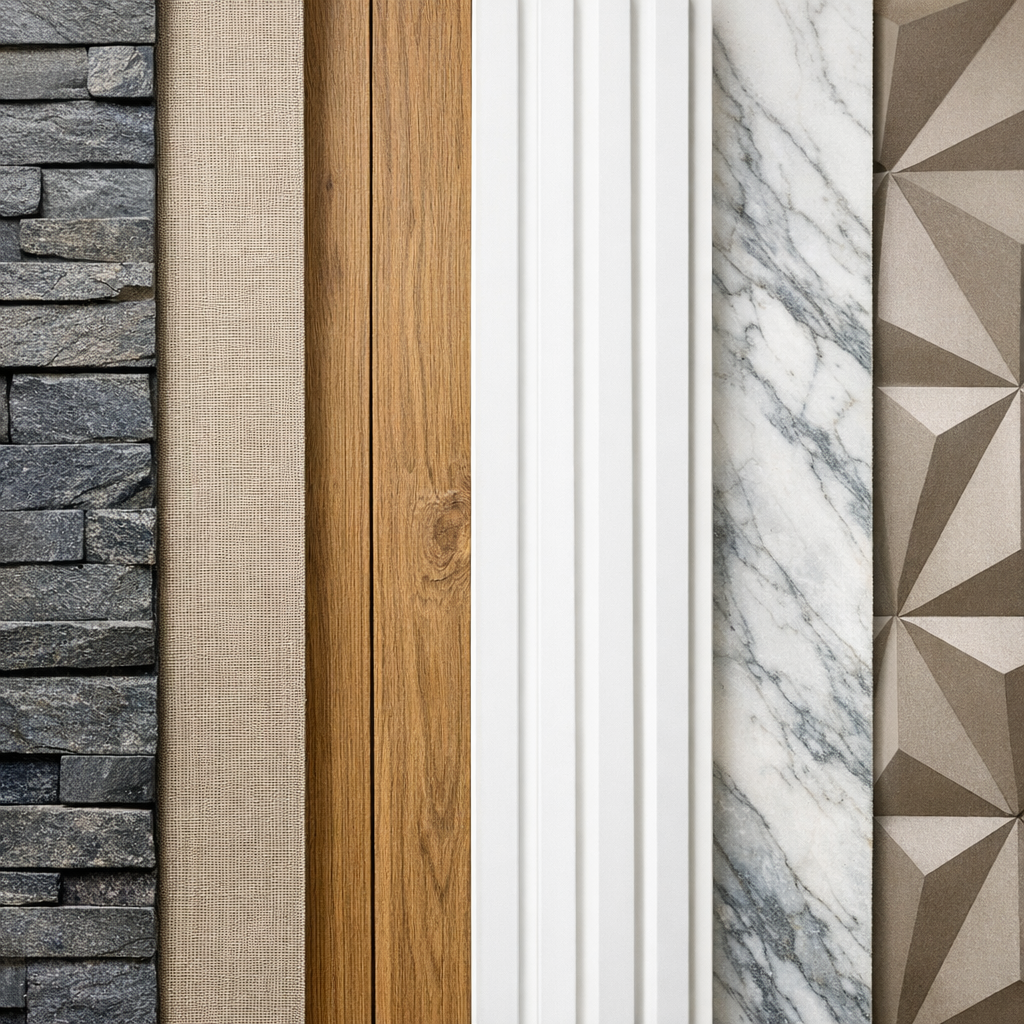
Walk into almost any modern commercial space, and chances are the walls are doing more work than you think. Wall panels have become a defining feature of Canadian business interiors and exteriors. But what types of wall panels are available for businesses, and how do you choose the right one?
The options are broader than most expect. From sleek metal cladding and moisture-resistant PVC to natural wood finishes and high-pressure laminates, each material brings its own strengths to the table. The choice isn't purely aesthetic, either. Canada's demanding climate — marked by sharp temperature swings and fluctuating humidity — demands durable materials.
Commercial wall cladding must also be engineered to withstand higher wind pressures, particularly on high-rise structures, and must comply with stringent fire safety standards under the National Building Code of Canada. This includes requirements like the CAN/ULC S134 test for fire spread. Depending on the industry, additional requirements around food-grade safety, chemical resistance, or environmental certification may apply. Choosing the wrong panel isn't just a design misstep — it can be a costly regulatory one. The good news? There's a panel built for nearly every need.
ACM and Insulated Metal Panels
Aluminum Composite Material (ACM) panels consist of two thin aluminum sheets bonded to a polyethylene or fire-retardant core. This sandwich structure delivers exceptional strength, weather resistance, and a weight of just 1.1 to 1.5 pounds per square foot — roughly 70 percent lighter than solid aluminum of the same thickness. Skins come pre-finished with high-performance PVDF or FEVE coatings for a rigid, ultra-flat surface ideal for exterior cladding, interior walls, and signage.
In Canada, ACM sheets run between $18 and $35 per square foot, with installation adding another $10 to $25 depending on complexity. Fire-retardant core panels are mandatory on any building over 18 metres under the Ontario Building Code. The investment pays off — Natural Resources Canada data from Toronto high-rises show ventilated ACM rainscreen systems cut annual heating and cooling costs by 18 to 22 percent. The Canadian aluminum composite panel market is projected to reach $256.5 million USD by 2030.
For those asking what types of wall panels offer the most complete building envelope solution, Insulated Metal Panels (IMPs) stand apart. These cutting-edge modular building materials can constitute the entire building envelope, providing a meticulously engineered thermal and moisture barrier. Acting as structure, insulation, and cladding in one, IMPs are 48 percent more energy-efficient and 55 percent more cost-effective than traditional wood construction, starting at $6 to $13 per square foot for materials.
Acoustic Wood Slat, PVC, and WPC Panels
Wood wall panels remain one of the most popular choices for commercial applications in Canada. Acoustic wood slat panels combine natural wood veneer, medium-density fibreboard, and sound-absorbing backing to tackle two challenges at once: aesthetics and noise control. Real wood veneer slats over engineered acoustic felt deliver NRC ratings of 0.65 to 0.85 — the Noise Reduction Coefficient measures how well a material absorbs sound across mid-range frequencies from 250 Hz to 2,000 Hz. For offices and conference rooms where speech clarity matters, panels rated 0.80 or higher are the benchmark.
PVC panels are gaining ground in commercial interiors for practical reasons. They address concerns about frequent renovations and tight maintenance budgets by offering predictable installation, stable long-term performance, and lower lifecycle costs — a compelling case for businesses watching operational expenses.
Wood-Plastic Composite (WPC) panels take a different approach, blending wood fibres with thermoplastics to deliver the warm natural appearance of wood alongside genuine moisture resistance and durability. Exterior WPC panels range from $18 to $80 per square metre depending on quality grade and finishing technology — a wide spread that reflects how much specification decisions matter. Demand is highest in Ontario, British Columbia, and Alberta, where urban construction activity continues to drive adoption.
Fibre Cement, Phenolic, and Prefabricated Panels
Fibre cement panels — made from cement, cellulose fibres, and sand — are gaining traction across Canada, particularly in the Greater Toronto Area. They resist rot, pests, heavy rain, high winds, and hail. Being non-combustible, they outperform many traditional siding materials on fire resistance, which can translate directly into lower insurance premiums in high-risk areas. When properly installed, fibre cement siding can also increase building energy efficiency and lower energy costs.
Phenolic panels take durability even further. Layers of kraft paper or wood fibres are impregnated with thermosetting phenolic resins, then compressed under extreme heat and pressure into a dense, solid-core board. The result: strong resistance to moisture, impact, and UV degradation with minimal upkeep. These waterproof and chemical-resistant panels are a go-to in laboratories, hospitals, schools, and commercial washrooms. Facilities managers report maintenance costs running 40 to 50 percent lower than fibre cement over a 30-year lifecycle — a figure worth factoring into any long-term budget.
Prefabricated wall panels offer another compelling option — complete wall sections built off-site and delivered ready to install. The efficiency gains are significant: builders can complete roughly two and a half times more projects using the same crew, while cutting wood use by 25 percent and wood waste by 30 percent. Systems incorporating continuous exterior insulation can push energy savings between 15 and 30 percent.
ADH Ecogen: Your Source for High-Quality Wall Panels in Canada
When it comes to sourcing high-quality wall panels for your Canadian commercial or residential project, ADH Ecogen delivers solutions built to perform. Based in Mississauga, Ontario, this Canadian-owned B2B company offers an extensive range of panels — from ACM and insulated metal panels to WPC and PVC systems — engineered to meet Canada's strict building codes, fire ratings, and environmental standards. With eco-certified materials, E0 emissions ratings, and custom specifications tailored to your project's exact needs, ADH Ecogen takes the complexity out of procurement. Explore their full offering of wall panel solutions in Canada and request a quote today.


